
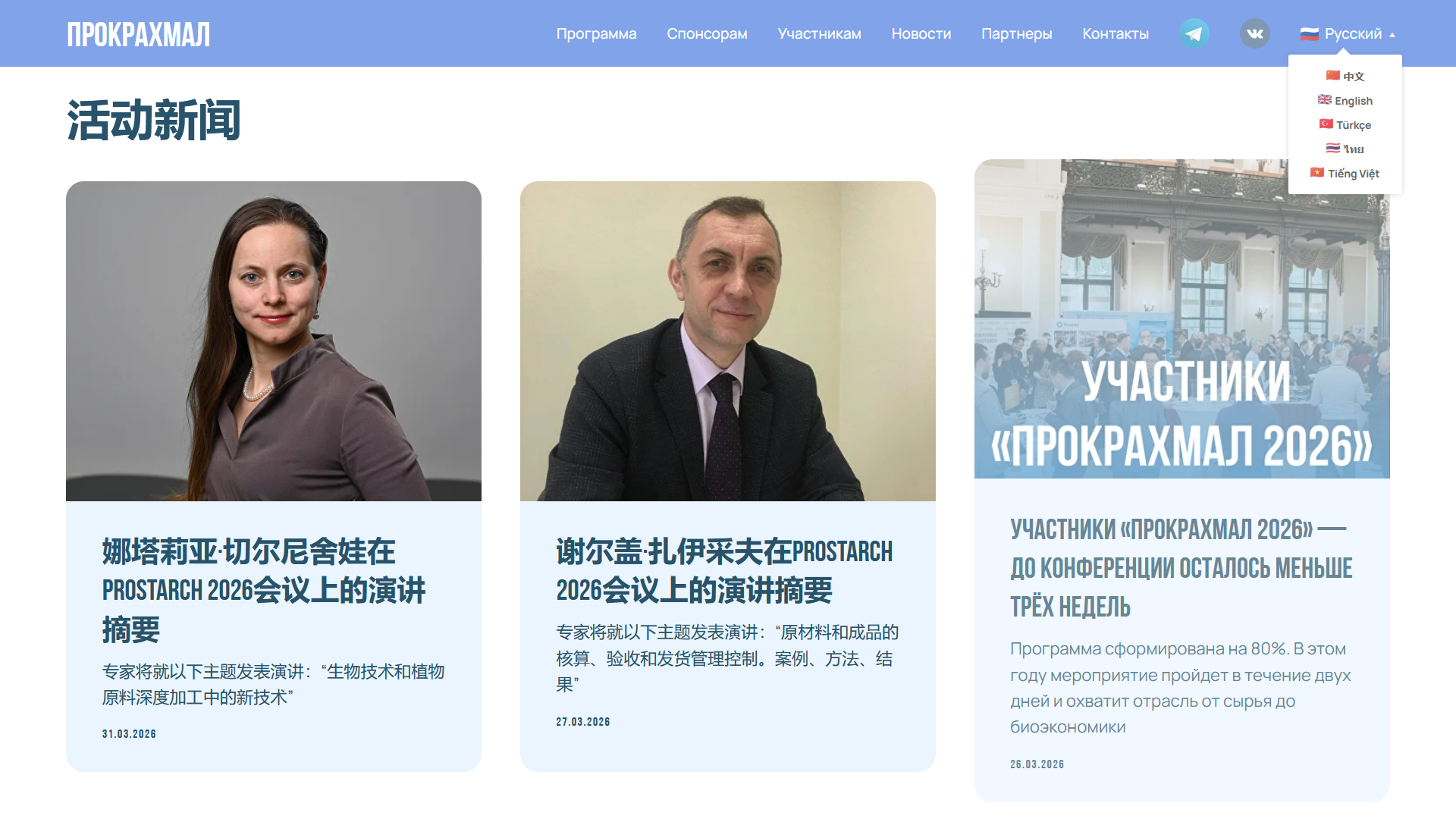
Client: the annual international conference "ProStarch" is an industry platform for specialists in the starch and syrup industry, organized by the SOYUZKRAHMAL Association. The conference takes place in Moscow and gathers participants from Russia and abroad. In 2026, the conference celebrates its 10th anniversary.
Task: the website was originally only in Russian. For the anniversary conference in 2026, it was necessary to attract foreign participants and partners, primarily from China, Turkey, and Southeast Asian countries. Launch a multilingual website accessible to all international partners.
Six Languages in One Launch
Six languages were connected for the conference: Russian, English, Chinese, Turkish, Vietnamese, and Thai.
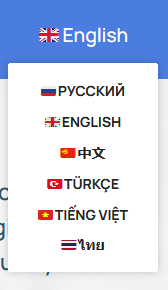
A flag-based switcher appeared in the website header. Each language version is available via a separate URL and is indexed by search engines: a user from Thailand can find the website through Thai Google.
Pages for sponsors and participants are translated into all languages, including detailed terms of participation and the feedback form.
However, in the case of this website, a simple connection was not enough — the site was designed using Zero Block without adaptive positioning (flexbox). This meant that when the text changed, the position of the elements did not change.
In addition, the site had several design elements that directly depended on the length of the text. So, we faced the first problem...
Visual adaptation of headings with different texts
The site is made on Tilda. One of the key blocks is the banner heading with a two-part structure: the first line is dark, the second is highlighted with color. In the Russian version, the block looked clean.
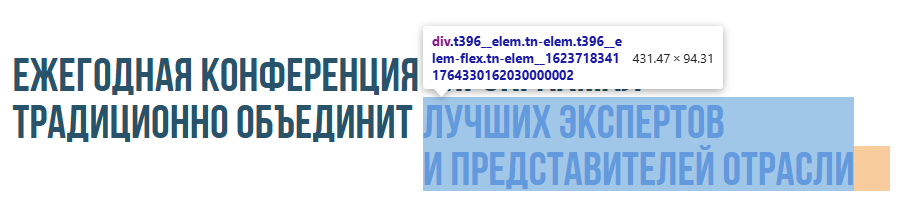
When translated into other languages, the highlighted block no longer matched the text: the text went beyond the block's boundaries and overlapped with adjacent elements.
Why? Tilda uses absolute positioning for some banner elements. The width of the highlighted block is fixed for Russian text. In other languages, the text has a different length and the text does not match. After editing the CSS, the block began to adapt to the text length:
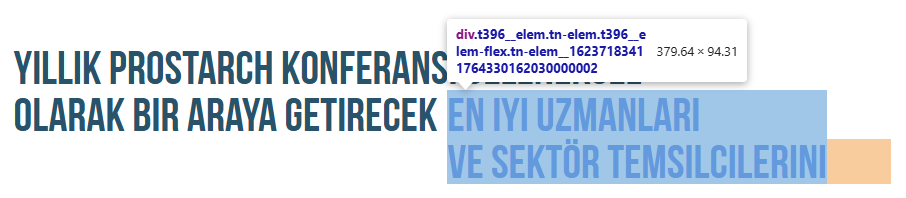
The same problem in reverse occurred in Chinese: the text was significantly shorter, and the block looked empty. So there we corrected the alignment:
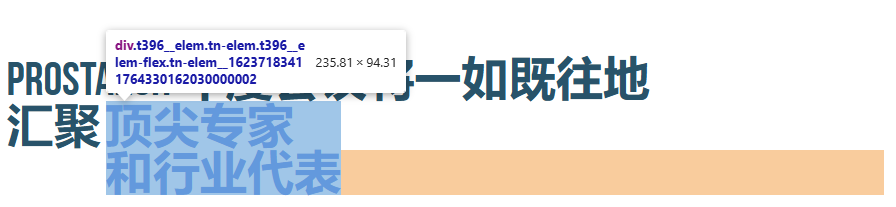
Now, for each version of the site, the designer's original concept was preserved, and visitors in any language saw the correct design.
Preserving wordplay using an instruction (prompt) for the neural network
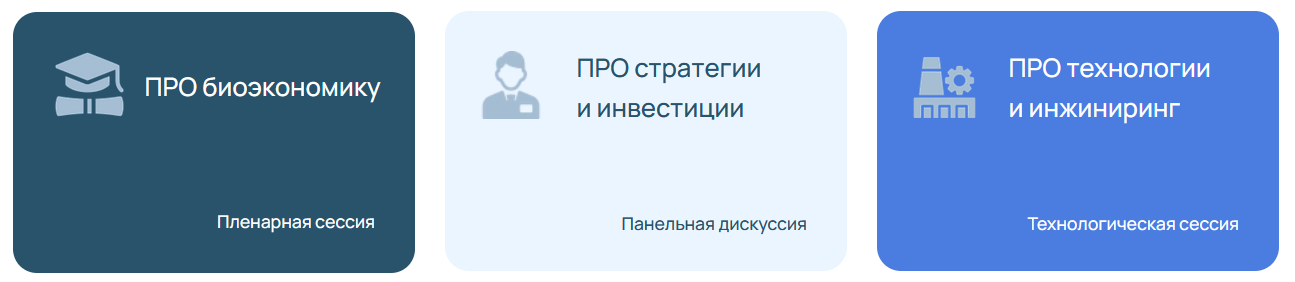
The original copywriting idea on the site was to use the prefix "PRO" for each direction. This was a wordplay on the conference name "ProStarch":
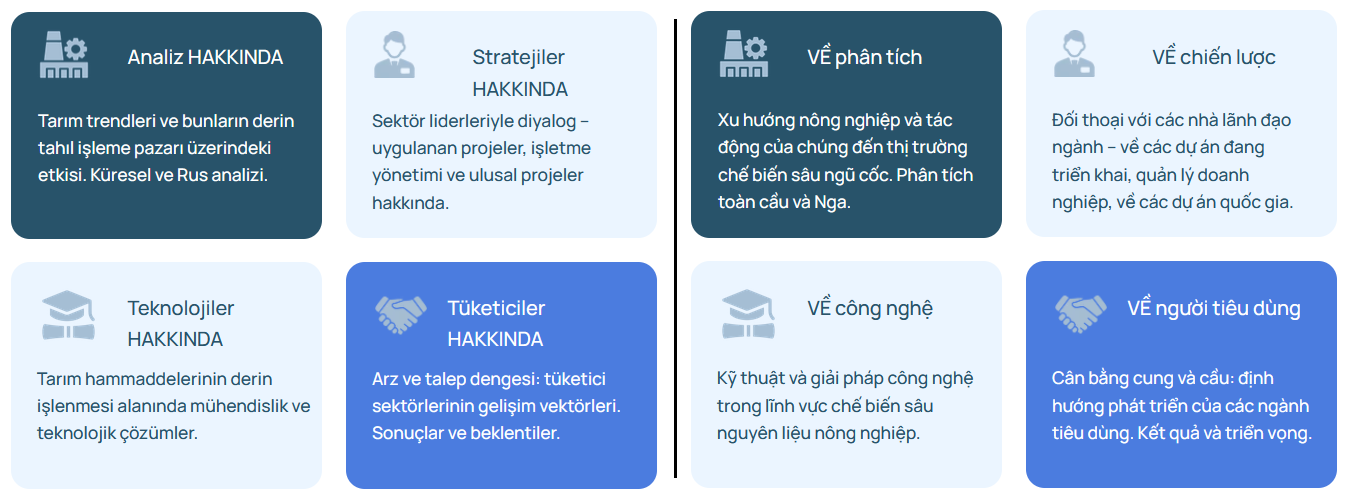
But here's the problem: initially, the neural network is not smart enough to understand this. Therefore, it translated the prefix literally:
To preserve this, we added a prompt (instruction) for the neural network to take this wordplay into account. Interestingly, the prompt was not aimed specifically at this block on the site — it gave a general instruction for the entire site. Therefore, if such wordplay were used elsewhere, the neural network would already "know" about it.
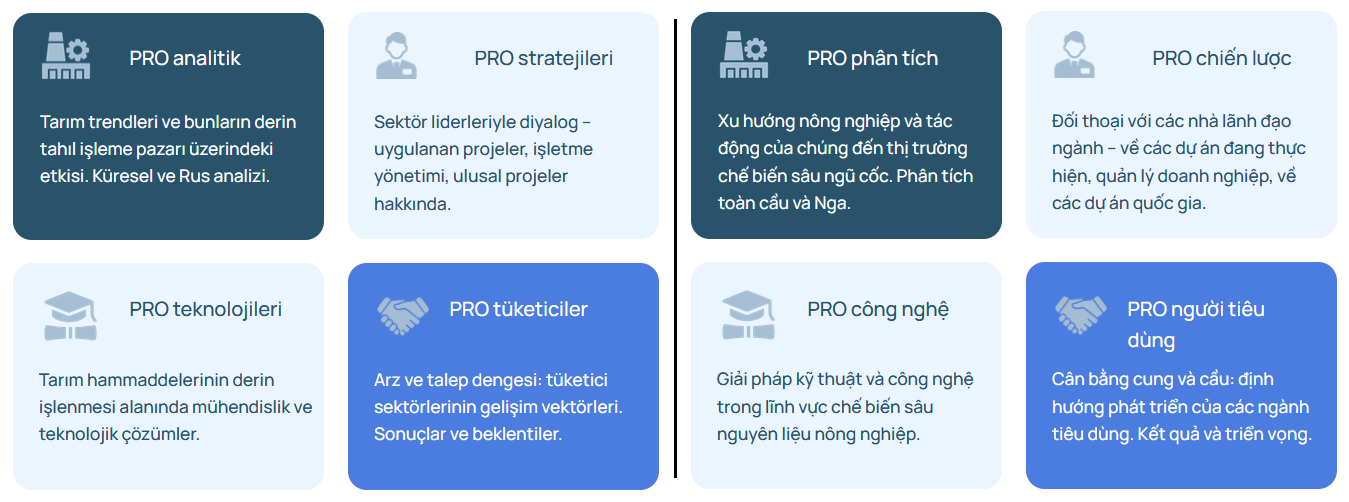
It was enough to set the following text with an explanation and examples:
"PRO аналитику", "PRO стратегию", "PRO технологии", "PRO потребителей" is
wordplay with the name of the conference "ProStarch", and it means "About"
the thing.

Do not translate the "PRO" part.
Industry glossary for accurate translation
This industry uses highly specialized and specific terminology. Standard translation without preparation uses common words where precise industry terms are needed.
Together with the organizers, we compiled a detailed glossary of key terms with correct English equivalents. The glossary also became part of the system prompt for the neural network, here is a fragment of it:
## Industry Terminology Glossary:

- ПроКрахмал => ProStarch
- ПроКрахмал: от сырья к биоэкономике => ProStarch: From Raw Materials to
  Bioeconomy
- Союзкрахмал => StarchUnion
- Ассоциация предприятий глубокой переработки зерна => Association of
  value-added grain processing companies
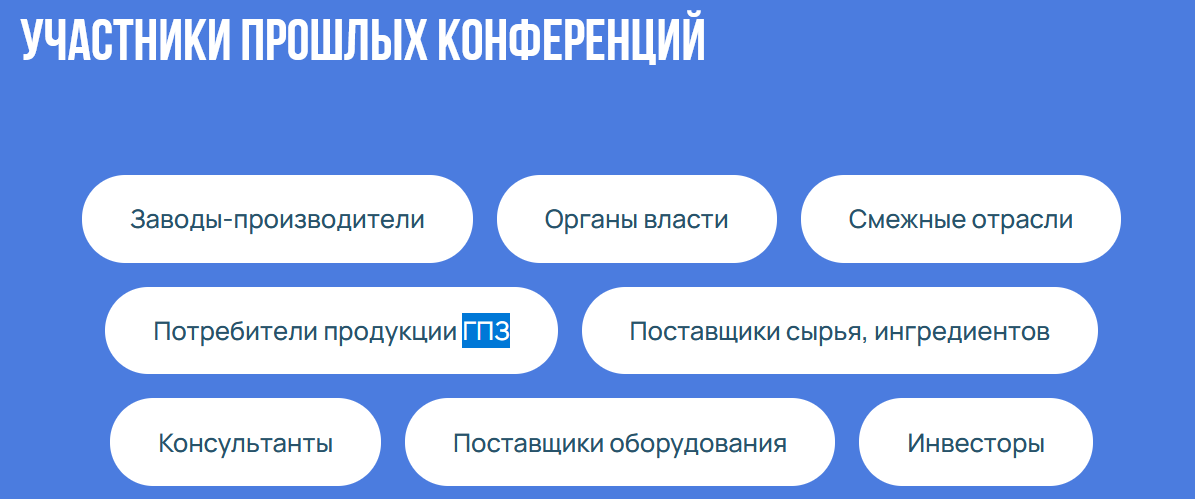
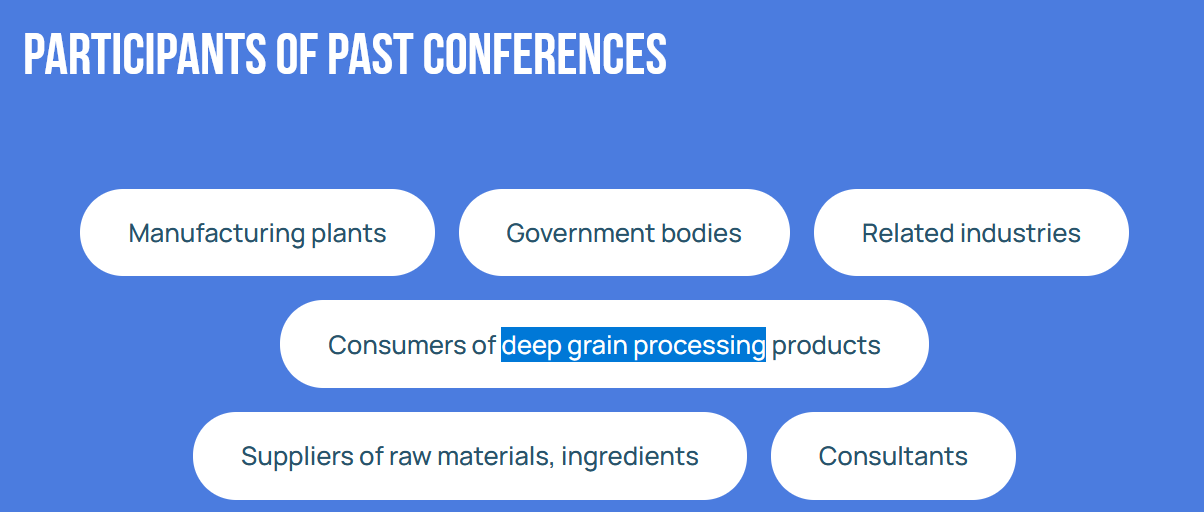
- ГПЗ => Deep grain processing
- ЕАЭС => Eurasian Economic Union (EAEU)
- ШОС => Shanghai Cooperation Organisation
- ГФС => Glucose-fructose syrup

...
Different video versions for different languages
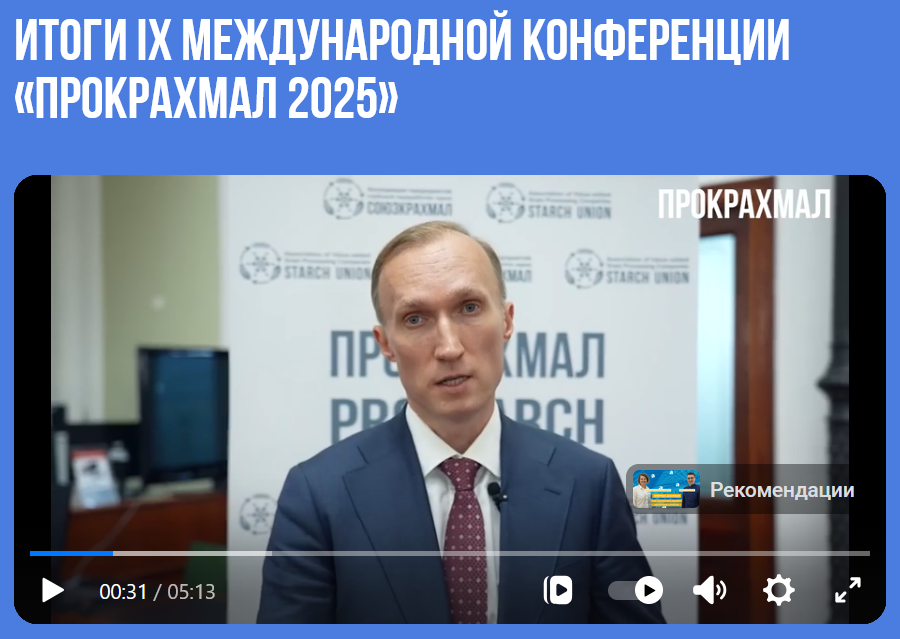
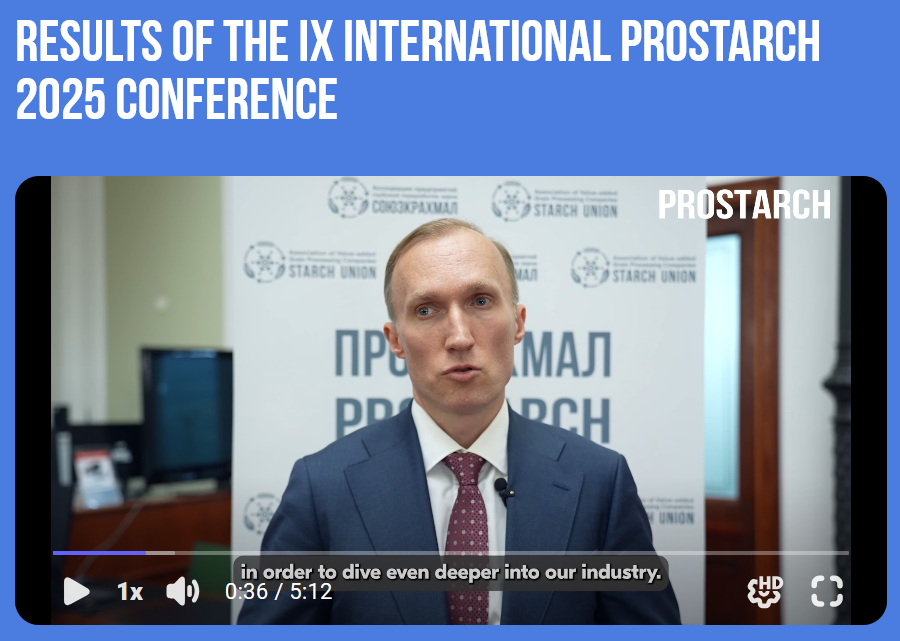
As promotional materials, the website uses videos in three languages: Russian, English, and Chinese. The correct video needed to be displayed depending on the website language.
This was implemented using CSS classes: each video block was assigned the class video-ru, video-cn, or video-en. Through rules for removing elements by selector, Multify removed "extra" videos directly from the HTML code before sending it to the browser. For example, for the English version, the rule is as follows:
"remove": [
  {
    "selector": ".video-ru, .video-cn"
  }
]
While for the Russian version, the English and Chinese versions of the videos are removed:
"remove": [
  {
    "selector": ".video-en, .video-cn"
  }
]
In the Tilda editor, in turn, all three video versions were created and overlaid on top of each other.
Localization of the Day Counter Modification
The main page uses a JavaScript modification with a counter showing the number of days until the conference. Similar to video display, text on the page can be replaced — including fragments of JavaScript code, which is what we did. And here, by the way, is the code — this time it turned out to be an ANNEXX modification:
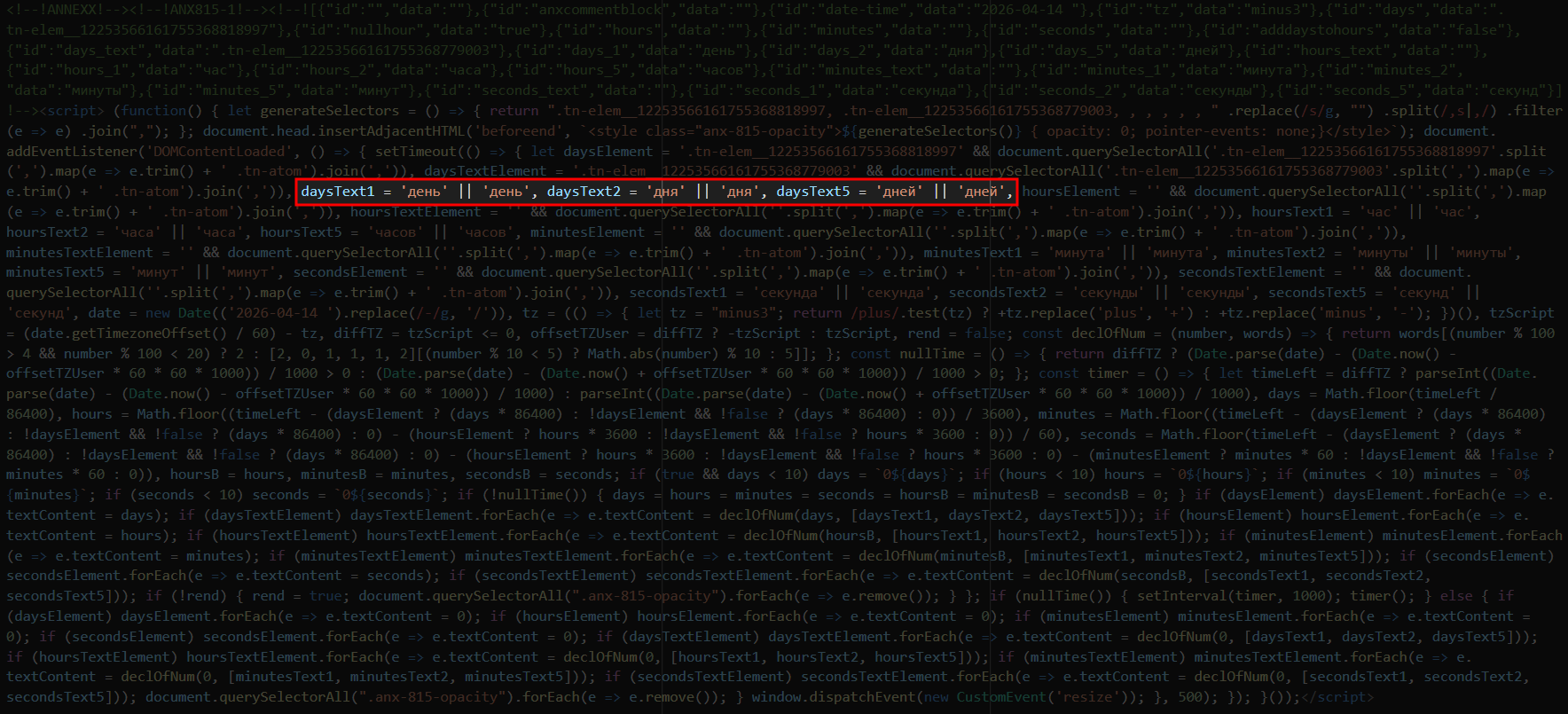
Here's how you can translate "дней" into English:
"replace": [
    [
        "daysText1 = 'день' || 'день', daysText2 = 'дня' || 'дня', daysText5 = 'дней' || 'дней'",
        "daysText1 = 'day' || 'days', daysText2 = 'days' || 'days', daysText5 = 'days' || 'days'"
    ],
],
And here's how to translate it into Chinese:
"replace": [
    [
        "daysText1 = 'день' || 'день', daysText2 = 'дня' || 'дня', daysText5 = 'дней' || 'дней'",
        "daysText1 = '天', daysText2 = '天', daysText5 = '天'"
    ],
],
As a result, the counter is displayed in the desired language on each version of the site:



Responsive Layout (flexbox)
It was previously mentioned that with absolute positioning of elements in Tilda (a common occurrence when laying out with Zero Block), elements are literally "nailed down" and therefore any change in the text within them can result in text overlapping other elements.
To avoid this, you can use the flexbox mechanism built into every browser. With this approach, elements become "flexible", meaning they adapt to the content themselves.
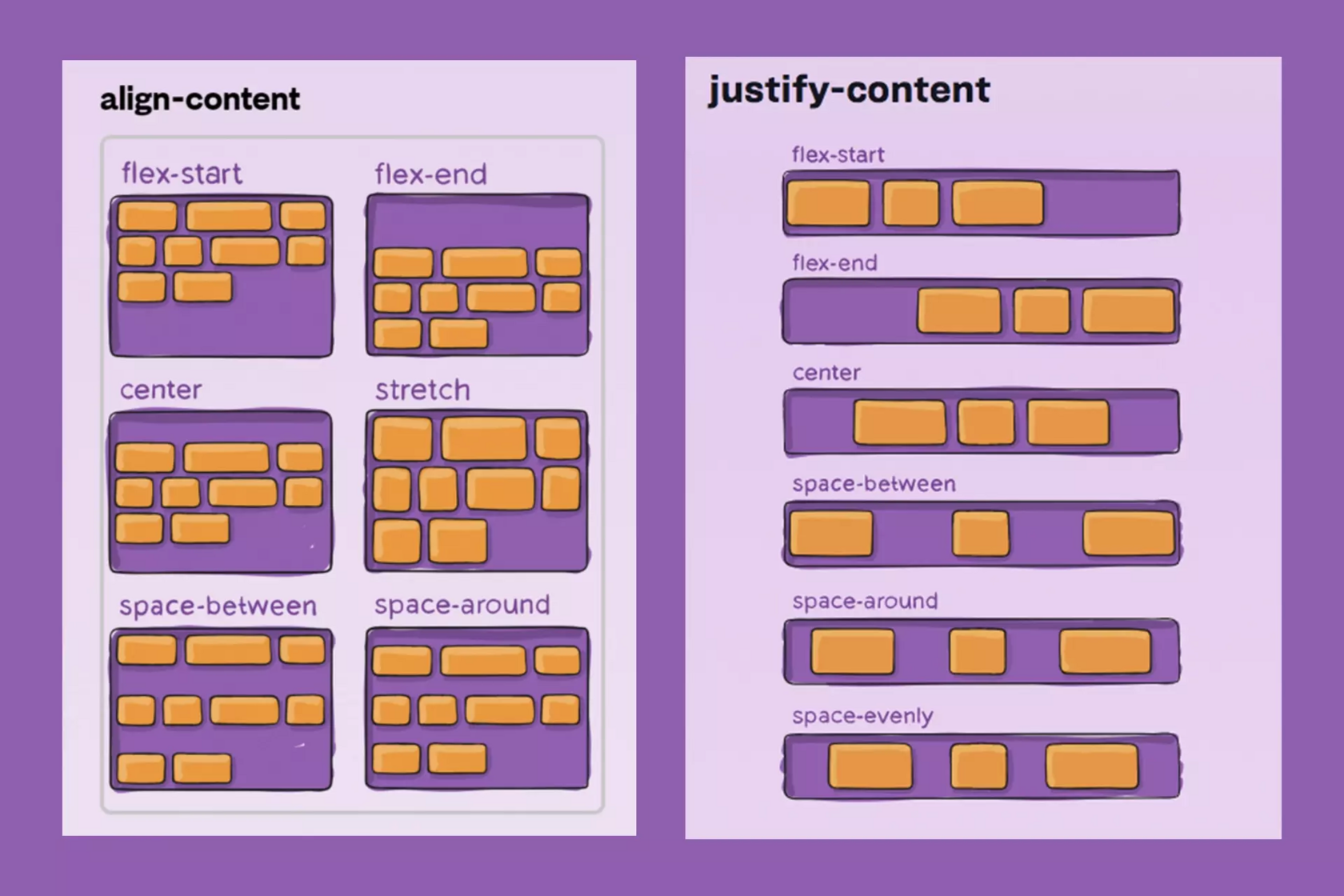
In practice, for the ProKrakhmal conference website, we updated the layout of most elements: capsules, lists, and cards. The difference is most clearly visible when comparing Russian and Chinese, because Chinese is significantly shorter:
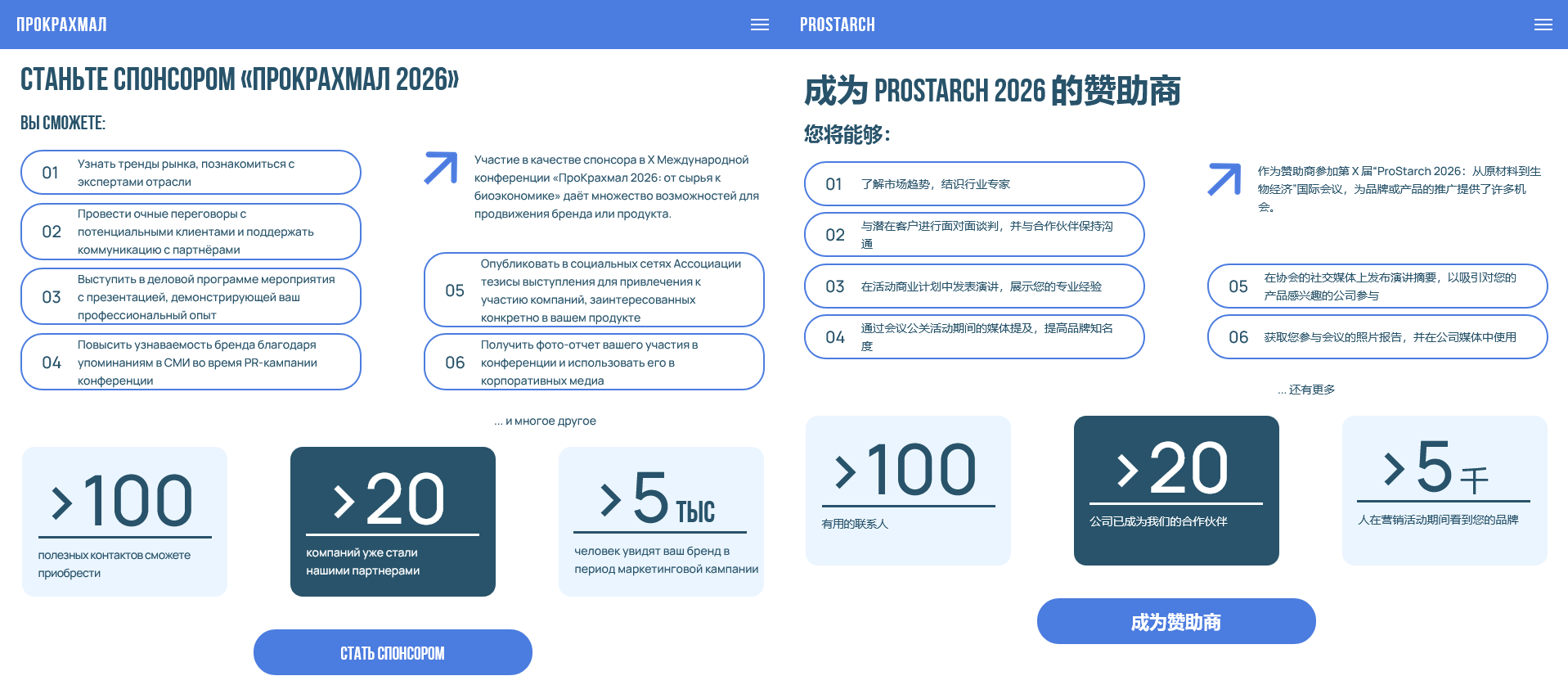
As a result, all content on the site is displayed correctly, regardless of how long or short the text is in the elements.
Conference Organizer's Review
Daria, organizer of the ProKrachmal conference:
This year, our international conference celebrates its 10th anniversary. In honor of this, we decided to launch our own website, but faced the problem of translating it into various foreign languages: many translators often use templated words, and we needed specific terms due to the narrow industry focus. There was also a difficulty in translating into several languages at once: Thai, Chinese, English, Turkish, and Vietnamese.
We decided to contact Multify and were very pleased! The specialist immediately advised us that everything could be set up once. He explained the nuances, calmly and patiently accepted edits.
A special dictionary was created for us for the correct translation of individual terms, and the website design was adapted for each language. We thank this service and are confident that our cooperation will continue for many years!
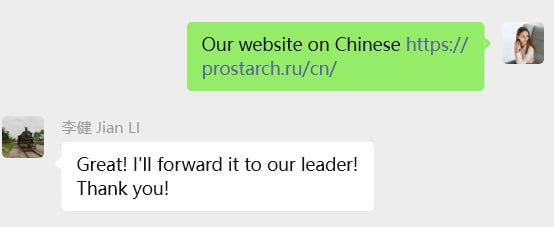
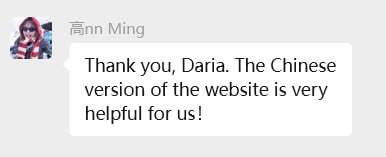
The conference's Chinese partners also appreciated the result:
Outcome
The prostarch.ru website has been operating in six languages since its launch. Language versions are available in search, the switcher works in the header, and pages for sponsors and participants are fully localized.
The specifics of the case are an unusual set of languages (Thai, Vietnamese, Turkish) and several technical nuances that required manual refinement of the layout. With a standard website without absolute positioning, most of these would not have arisen.